https://irelanddecourcydewhurst.blogspot.com
The information below was taken from Elizabeth Rennick's book "A Family Portfolio".
Many thanks Elizabeth for allowing your research to be used in this Blog.


Many thanks Elizabeth for allowing your research to be used in this Blog.
Introduction
Our ancestors who first came to Australia were, like most settlers then, from the British Isles, in our case English, Irish and Scottish. Like all families they could be traced back into antiquity if one only had the details, but we can certainly trace some lines back a very long way.
The English branches are the Rowes, the Lowes and the Ruffys.
The Scots are represented by the Hays.
The Irish comprise the Irelands, the De Courcy and the Aherns.
There are cross-currents between England and Ireland among the Carrs, the Irelands and the De Courcys.
Interestingly, there are French origins in three branches of the family (though in two cases very remote) and they all emanate from within a short distance of one another in Normandy. The Hays trace their pre-Scottish origins to LeHaye du Puits, not far from Cherbourg. The Norman-Irish De Courcys are linked with two villages of the name Courcy in Normandy, and the Ruffys emigrated to London from the town of Luneray, near Dieppe.
Two quite separate branches of the family originated in Lancashire: the Rowes, who lived for generations in Wigan, and the Irelands, who were for several centuries lords of the manor in the Merseyside village of Hale, northern England, before one branch crossed to Ireland.
You will see from the accompanying family trees how all these branches feed into our family today.
This history, like so many others, is unavoidably weighted towards men and male achievements, because these, and not often considerable private achievements and heroism of women, are more likely to be on public record. However, women members of the family. at least until fairly recently, have been the most assiduous in preserving alive family lore, information, anecdotes and traditions, and generally safeguarding what family knowledge was available.
The Irish have long memories so it seems fitting that the branches we can trace back farthest are three Irish lines - the Irelands, the Carrs and the De Courcys.
The Irelands have been traced back to the 12th century, when just to confuse matters, they lived in England.
The De Courcy - Norman-Irish who married into the Ireland family, can be traced at least to the Norman Conquest and according to some sources as far back as Charlemagne in the 700s, but the evidence for this is somewhat in dispute.
The Carrs, Irish, although they originated in England, can be traced back to the early 1600s.
Other lines of the family are traceable as far as the 1600s (the Rowes), and the late 1700s (the Hays). In the case of George and Norah Lowe we have no information on their predecessors.
A simplified pedigree of the families recorded in "A Family Portfolio"
by Elizabeth Rennick


My interest has been in the Ireland, De Coucey and Dewhurst families. If you wish to follow up on the Hay, Ruffy, Rowe, Lowe and Ahern families you will need to contact Elizabeth Rennick for you very own copy of "A Family Portfolio".
The Irelands
Ireland Family Tree from 1196
Main ancestors: Adam de Ireland, Captain James Stanley Ireland and Richard Davies Ireland.
Elizabeth states that virtually all of this section is from the Victorian Histories of the Counties of England: Duchy of Lancashire, and from the genealogical studies of John Ireland, who has kindly allowed her to use the results of his extensive research. (See Sophia Carr & Richard Ireland's family tree chart. John Ireland born 18 November 1926 was the grandson of De Courcy Ireland and great grandson of Richard Ireland).
Summary:
Summary:
The Irelands are the line that has so far been traced back farthest of all the branches of the family. The earliest ancestor of whom we have details was living in the 1100s. He was called not Ireland at that stage, but Gilbert de Walton. This Gilbert's son Richard de Meath, was given a grant of a manor called Hale, at the tiny settlement of Hale, near Liverpool, in the the early 1200s.
The name Ireland arose when a later heir to the manor, a young man called Adam, born and brought up in Ireland, turned up in England to claim his inheritance. Known as Adam de Ireland, his descendants from there on were called Ireland. In fact, a branch of the family did go back to Ireland, but not until some centuries later, in the 1600s.
The manor at Hale passed down through generations of Irelands until about 1675, when through marriage it passed to another family. Sadly, there is virtually nothing left nwo of the "modern" manor house, a fine building, with mullioned windows and gables, built in the 1600s.
Our branch of the family settled in Ireland, the earliest marrying Margaret de Courcy, of the Norman-Irish family of the Barons of Kinsale, in the 1600s. (See De Courcy).
The Irelands were solid member of the Irish ascendency, with many of them down the generations serving as Church of England clergy and prominent in the army and the law.
Our most noted Ireland ancestor was Richard Davies Ireland QC, who came to Victoria last century. A celebrated and colourful figure, both as a barrister and a member of the Victorian parliament. R.D.Ireland served as Victorian Solicitor-General and Attorney-General in the 1850s and 1860s and achieved fame at the bar partly through his defence of men involved in the Eureka Stockade. It was aid that by the time he died he had gone through four fortunes. He was married to Sophia Carr.
 |
| Where the Irelands came from: the north west of England, showing the village of Hale, near Liverpool, on the River Mersey. |
 |
| Flat riverland country around the village of Hale. A quiet, unspoiled corner on a small peninsula in the great Mersey River, some kilometres from Liverpool. |
 |
| Winding main street through the village of Hale. First recorded as Hales in the 1100s. The village probably derives its name from the Anglo-Sazon word "healh", meaning a small corner of land. |
 |
| (For a full pedigree go to the end of this Post). |
Gilbert De Walton died 1196.
His son was Richard De Walton
died 1235. Also known as Richard De
Meath or Richard De Mida, a clerk of the exchequer. Richard was granted the manor of Hale, County
of Lancaster by King John of Magna Carta fame on 9 November 1203. Hales was north-west of England near
Liverpool, on the River Mersey. Richard
was in Holy Orders (probably a Priest), therefore not married, but allied to Cicely De Columbers to whom he willed
the estate.
Their illegitimate children were:
Richard died pre 1260.
Geoffrey died pre 1260.
Adam died pre 1260.
Henry died 1260 and married Cecily DeHolland.
Emma died pre 1260.
Cecily married John De Wolfall.
Edusa married and had
a son Adam Austin de Irelande.
The next heir after Cecily and
all her children was Adam Austin, son of Cecily’s youngest daughter Edusa. Known as Adam
de Irelande, he made a claim to his inheritance, so his descendants from
there on were called Ireland. It was
fortunate that Adam married Avina, daughter of the new overlord of the manor,
Robert de Holland, thus giving the young heir a larger slab of land than he
already claimed. Adam’s son John
eventually inherited the original Hale manor.
His son David de Ireland inherited it in the 1300s.
Several of the descendants were
knighted. John Ireland, son of David Ireland was knighted by King Henry IV
when he seized the throne from Richard 11.
A later John Ireland was knighted in 1497 by Lord Strange. This Sir John died on 29 July 1525.
His great grandson, was
lieutenant of the Isle of Man in 1611.
He died on 17 October 1614 and was buried at Hale.
That younger John’s brother Gilbert Ireland was also made a knight in 1617 during King James’s stay at
Lathom, the nearby Stanley estate. He
served as a sheriff of Lancashire in 1622.
A later Gilbert Ireland was embroiled in the English Civil War, taking the
side of Parliament with the rank of colonel. He served in various official
capacities in Lancashire as high Sheriff in 1648, as governor of Liverpool
Castle, as governor of Chester and as a member of parliament for Liverpool from
1658 until his death in 1675. As an avid
supporter of Oliver Cromwell, Gilbert Ireland was one of the equerries at the
Protector’s funeral and followed the hearse into Westminster Abbey. However,
when a new parliament was called by Richard Cromwell in January 1659, Gilbert
Ireland joined forces with those seeking the restoration of the monarchy. When King Charles II returned to the throne,
Gilbert welcomed the King on behalf of the Lancashire and Cheshire gentry. In 1660 he was knighted for his services to
the monarch and five years later in 1665, he was appointed deputy lieutenant of
Lancashire. This Sir Gilbert Ireland II has been described as a “man of unbounded hospitality
….his disposition, however, was haughty and his demeanour stately”. It is said that he was fond of elections and
maintained a contest for Liverpool on several occasions, the last of which from
too much drinking and too many money squandering proved fatal to his health and
injurious to his purse. Sir Gilbert died of apoplexy on 30 April 1675 and was
buried at Hale, his wife dying two months later. Sir Gilbert Ireland was the last Ireland to
have the manor of Hale.
The manor at Hale passed down
through generations of Irelands until about 1675, when through marriage it
passed to the De Courcy family. *
Our branch of the family settled
in Ireland, the earliest marrying Margaret de Courcy, of the Norman-Irish
family of the Barons of Kinsale, in the 1600s.
The Irelands were solid members
of the Irish ascendency, with many of them down the generations serving as
Church of Ireland clergy and prominent in the army and the law.
Our most noted Ireland ancestor
in Australia was Richard Davies Ireland QC, who came to Victoria last
century. A celebrated and colourful
figure, both as a barrister and a member of the Victorian parliament. R.D.Ireland served as Victorian Solicitor-General
and Attorney-General in the 1850s and 1860s and achieved fame at the bar partly
through his defence of men involved in the Eureka Stockade. It was aid that by the time he died he had
gone through four fortunes. He was
married to Sophia Carr.
Now back to the family tree.
Adam De Ireland (died 1324) married
Avina Holland in 1285. They had 2
sons – John and Richard.
John Ireland married Agatha
De Merton.
John Ireland and Agatha De Merton
had a son David Ireland.
David Ireland married Margaret Stanley & had 2 children:
1. Sir John Ireland married Margaret Hallsall and they had 5 children
– William, Thomas, Joan, Katherine
and Margaret.
2. Emma Ireland married John De
Bolde.
William Ireland
(died 1435) married Ellen Honford.
William Ireland and Ellen Honford had a son John Ireland (died 1462).
John Ireland married Margery Atherton and had a son William Ireland.
William Ireland married Elinor Molyneux and had three children:
1. Sir John Ireland of the Hutte and Hale (died 1525) married Margery Stanley.
2. Thomas Ireland married
Margery, dau of Whitby of Ince.
3. Alice married William Moore.
Sir John Ireland and Margery Stanley had three children:
1. Thomas Ireland of the Hutte
and Hale (died 27 August 1545) married
Margaret De Bolde.
2. Elizabeth Ireland married
Richard Lathom.
3. Alice Ireland married Robert
Risley Divorced 1536.
Thomas Ireland and Margaret De Bolde had six children:
1. John Ireland (died 20 July
1545) married Margaret ?
2. George Ireland (died 12 July 1596) married (1) Elizabeth Birkenhead (died 1579/80) married (2)
Elizabeth Colwich.
3. Margaret Ireland married (1)
John Aston and married (2) Sir George Beeson.
4. Anne Ireland married William
Aston.
5. Mary Ireland married Hugh
Dutton.
6. Alice Ireland.
George Ireland and Elizabeth Birkenhead had eight children:
1. John Ireland married Katherine
Leycester.
2. Sir Gilbert Ireland (knighted 1617 & died 1626) married (1)
Dorothy, married (2) Barbara Leighe.
3. Anne Ireland.
4. Mary Ireland.
5. Elizabeth Ireland.
6. Dorothy Ireland.
7. George Ireland.
8. Thomas Ireland.
Sir Gilbert Ireland (knighted 1617 and died 1626) and Barbara Leighe (his
niece) had 2 children:
1. John Ireland of the Hutte
and Hale (22 November 1601-5.5.1633) married
Elizabeth Hayes. They had Sir
Gilbert Ireland (8 April 1624-30 April 1675) and he was knighted 10 June
1660.
Sir
Gilbert Ireland married Margaret
Ireland of the Halewood Irelands. (born 31 July 1630 – 15 July 1675). John Ireland and Elizabeth Hayes also had
five daughters, and three sons who died young.
2. George Ireland (1607-1668) married
?. They had a son William Ireland (1630-1689).
William Ireland married Margaret de Courcy (daughter of Henry de
Courcy, first cousin of Earl of Kinsale).
William Ireland and Margaret De Courcy had a son De Courcy Ireland.
Colonial De Courcy Ireland married
(1) Anne Trendall divorced 1702. Married
(2) Margaret Blanchfield (died 1706).
Married (3) Judith Hawkins.
De Courcy Ireland and Anne
Trendall had a son Richard Ireland.
Richard Ireland married Catherine Lynch.
Richard Ireland and Catherine Lynch
had a son (The Very Rev.) William
Ireland (1712-13 January 1787 Cong County, Mayo, Ireland).
William Ireland born 1712 and died 13 January 1787 in Cong County, Mayo, Ireland married Magdalen Irwin born 1725 and died 1785 in Lisbally, Ireland.
William Ireland and Magdalen Irwin
had 11 children:
1. DeCourcy Ireland married
Susanna Stanley on 4 July 1774 (refer to another Blog).
2. Richard DeCourcy Ireland born 1750 in Roscommon, Ireland and died 1814. Richard married Elizabeth Maria Stanley on 20 January 1778.
3. Male Ireland.
4. William DeCourcy Ireland died 1770.
5. Magdalen Ireland married John
Burke.
6. Letitia Ireland born 1751 and died 1813 in Baddersley. Letitia married James
Hughes.
7. Anne Ireland married (Very Rev)
Edward French.
8. Female Ireland married James
Stanley.
9. Margaret Ireland died 1777.
10. Female Ireland.
11. Female Ireland.
(All these Stanleys are siblings).
(One of those Female Irelands was Elizabeth Ireland born 1766 in Bethlehem, Kilkenny West, Westmeath, Ireland).
(One of those Female Irelands was Elizabeth Ireland born 1766 in Bethlehem, Kilkenny West, Westmeath, Ireland).
Richard Ireland and Elizabeth
Stanley had 8 children:
1. William Ireland died 1812/1 in
service in Peninsular War.
2. (Capt) James Stanley Ireland (died 1856) married Matilda Davies.
3. Richard Irwin Ireland survived
the War and died in the West Indies in 1826.
4. Edmond Kelly Ireland died 1811
in service in Peninsular War.
5. De Courcy Ireland died 1812 in
service in Peninsular War.
6. ? Ireland died 1812 in service
in Peninsular War.
7. Catherine Ireland married John
Young.
8. Magdalen Ireland married
Gerald Burke.
(Capt.) James Stanley Ireland and Matilda Davies had 8 children:
1. Richard Davies Ireland QC (27 October 1815 – 11 January 1877)
married Sophia Mary Carr (1821 – 27 November 1875).
2. Elizabeth Maria Beatrice
Ireland (born 17 November 1818) married Comte Henri De Brahu.
3. James Stanley Ireland (born 6
November 1819).
4. Catherine Sophia Geraldine
Ireland (born 15 November 1821) married John William Carleton QC.
5. Matilda Ireland (died young).
6. Harriet Leonora Frances
Ireland (born 6 May 1826) married (Col) Richard Osborne Tilden.
7. Jane Ireland (died 22 March
1828).
8. Nannie Olivia de Courcy
Ireland married Edward Manning.
Sadly, there is nothing now left of the Hutte manor house and only fragments of Hale Hall.
Ireland family traced back to Hale
The Ireland family has its origins in flat, riverland country around the River Mersey in the area of Liverpool. It is curious that two quite separate branches of the family, to be united centuries later by marriage in Australia, should have originated in the same general area of England's north-west. For the Rowes originated in Wigan, Lancashire, and the later forebears from Aintree, on the outskirts of Liverpool (see Rowe).
We can trace the Ireland family back to the village of Hale, on the river Mersey. First recorded as Hales (1) in the 1100s, the settlement is set in flat landscape, with farms, occasional swamps, and little high ground, but with rows of tall Lombardy poplars, at least until recent times, punctuating the landscape.
The village boasts a historic celebrity called the Childe of Hale, a giant of 9 foot 3 inches who lived in the 1600s. His real name was John Middleton and he is buried in the Hale churchyard (2). Such was Middleton's extraordinary height that he was taken to London in 1617 to be shown off to James 1, who rewarded him for his huge height with the princely sum of 20 Pounds. Middleton was later in his life employed by Sir Gilbert Ireland as a bodyguard, his massive size the perfect deterrent to intruders.
The first "Ireland" we have record of is actually a man called Gilbert de Walton, who would have been living in the 1100s - he died in 1196. We know little about him, but his son, Richard de Walton, later called Richard de Meath, a clerk of the exchequer, was given the manor of Hale by King John of Magna Carta fame on November 9, 1201.
Richard was in holy orders, probably a priest, though he may have been a deacon or in minor orders. He was attached to a church and receiving a benefice. In 1185 Henry 11, in a move to make a complete conquest of Ireland, sent his son John (later King John) over to conduct the campaign. Among his followers was Richard de Walton, who accompanied his apparently in a clerical capacity. Spending most of the time in County Meath he became known as Richard de Mida or Richard of Meath. Richard "allied himself" with a lady named Cecily de Columbers, though he was not married to her (3). His non-marriage suggests he was probably a priest.
We know little of these early Irelands except who married whom - or did not marry whom - and who inherited various estates, because the only records we have are of wills and legal transactions of various sorts.
We know that after Richard's death, Cecily and her six children (Richard, Geoffrey, Adam, Henry, Cecilia and Edusa) managed to hang on to the Hale estate, despite their illegitimacy, under the overlordship of a Henry de Walton, her brother-in-law, for under the feudal system everyone owed allegiance to someone higher, even the barons owing allegiance to the King.
The next heir after Cecily and all her children was an Adam Austin, son of Cecily's younger daughter Edusa, who had been born and brought up in Ireland and was known as Adam de Irelande. Thus by the mere chance that Adam happened to have been in Ireland at the time of his coming into the property, the name Ireland became stamped on the family from then onwards. He came over to Lancashire to claim his inheritance, touching off a legal wrangle and probably a family squabble as to what he was or was not entitled to. The whole matter had been complicated initially, of course, by Cecily's not being married and her children being illegitimate. But it ended rather tidily when Adam married Avina, daughter of the new overlord of the manor, Robert de Holland, some time before 1286, thus giving the young heir a larger slab of land than he already claimed. Adam's son John eventually inherited all of the original Hale manor and bought further parcels of land. His son David de Ireland inherited it in the 1300s and in 1367 there is record of the bishop of Lichfield granting his a licence to have an oratory at the manor house.
From then on the manor of Hale passed down various generations of Ireland (see family tree).
Several of the descendants were knighted. A John Ireland, son of David Ireland who got the licence for the oratory, was knighted by Henry 1V when he seized the throne from Richard 11, no doubt in payment for allegiance by John in this bit of royal mayhem.
A later John was knighted in 1497 by Lord Strange, son of Earl Stanley, in Scotland during the expedition led by the earl of Surrey. This Sir John died on July 29 1515 "seized of the manors of Hutte and Hale, held of the earl of Derby in socage by a rent of two roses, the value being about 40 Pounds".
Sir John's great grandson John was apparently lieutenant on the Isle of Man in 1611. He died on October 17 1614 and was buried at Hale.
That younger John's brother Gilbert was also made a knight in 1617 during King James's stay at Lathom, the nearby Stanley estate. He served as sheriff of Lancashire in 1622 and was buried at the Hutte in April 1626.
A later Gilbert Ireland was embroiled in the English Civil War, taking the side of Parliament with the rank of colonel. He served in various official capacities in Lancashire - as high sheriff in 1648, as governor of Liverpool Castle, as governor of Chester and as member of parliament for Liverpool from 1658 until his death in 1675. He was knighted June 10 1660.
An avid supported of Oliver Cromwell, Gilbert Ireland was one of the equerries at the Protector's funeral and followed the hearse into Westminster Abbey. However, when a new parliament was called by Richard Cromwell in January 1659, Gilbert joined forces with those seeking the restoration of the monarchy. When King Charles 11 returned to the throne, Gilbert welcomed the King on behalf of the Lancashire and Chester gentry. In 1660 he was knighted for his services to the monarch and five years later, in 1665, he was appointed deputy lieutenant of Lancashire. It was about that time that he undertook extensive renovations to Hale Hall, which had been built by his grandfather and namesake early that century.
This Sir Gilbert Ireland 11 has been described as a "man of unbounded hospitality ......his disposition, however, was haughty and his demeanour stately".
It is said that he was fond of elections and maintained a contest for Liverpool on several occasions, the last of which from too much drinking and too much money squandered, proved fatal to his health and injurious to his purse. He sounds somewhat like our more immediate ancestor Richard Davies Ireland. Sir Gilbert died of apoplexy on April 30 1675 and was buried at Hale, his wife dying two months later.
Sir Gilbert Ireland was really the last Ireland to have the manor of Hale. The estate then passed to a nephew, then to other relations of the name of Aspinwall, and then to the Blackburne family, who remained there until the 1930s.
The Hutte and Hale estates need some explaining. At the time of the first "Ireland", Adam de Ireland, there was a manor of Hutte and Hale, which included a wood, called Hale Wood- eventually Halewood. Hale Wood was a royal hunting forest that was largely uninhabited except for the Hutte itself, a moated manor house about four kilometres from the village of Hale. The Hutte eventually became dilapidated, and the Irelands moved their residence to a site adjoining the village, building what was to become Hale Hall. Under the hierarchical system of administration, the Irelands, while Lords of the Manor, owed allegiance in turn to overlords and superior lords, such as the Hollands and the Earls of Derby.
 |
| The village of Hale as it is today, showing the site of the Old Hutte, Hale Hall, Childe of Hale's cottage. |
Sadly, there is nothing now left of the Hutte manor house and only fragments of Hale Hall.
It was in the 1600s that the
first Ireland actually “went back” to Ireland.
William Ireland (c 1630-1689), settled in Athy, Co. Laois, buying land
there and marrying Margaret De Courcy about 1667. What prompted him to settle in Ireland is not clear, though it was at a time when Englishmen were going to Ireland to acquire land and better themselves - mostly the land was confiscated but it is interesting that in William's case he actually bought it.
William lost the property in 1689 when by an act of the Irish parliament, Protestant landholders were dispossessed of land acquired since about 1640 because of the return of James II. William understandably objected. He had bought his property in the normal way and saw no reason why he should hand it "back" to anyone. His refusal brought him a term of imprisonment in the Athy jail where he died.
It may have been for this reason that their son went into the army, which was unusual for an only son if the father had land. It was this son, Colonel de Courcy Ireland, who bought Ireland’s Grove in Co.Laois (Queen’s County).
It was his father, William Ireland, who in the 1600s married Margaret de Courcy, of the Norman-Irish family of barons. (see De Courceys). There are strong doubts about which de Courcy Margaret was actually the daughter of. Two wills give her as the daughter of a Henry de Courcy, but other evidence conflicts with this. The union of the De Courcy and the Irelands meant that virtually from then on generations of Ireland were to include De Courcy as a first or second or hyphened name.
The Irelands have been prominent in various spheres down the intervening centuries between the earliest members of the family in Lancashire to the more recent past.
The Irelands were almost certainly present at the famous Battle of Bosworth, (4) where the Stanleys - with whom they were later to be related by marriage - won the battle for the Tudors by changing sides against King Richard 111. Since the Irelands were both vassals and in some cases in-laws of the Stanleys, they would most certainly have been expected to back the Stanley forces. The Irelands continued to hold the manors of Hale and Halewood by tendering the Stanleys two roses on Midsummer day.
According to John Ireland, George Ireland who married Elizabeth Birkenhead in the 1500s, was a recusant Catholic (5) for 40 years under Queen Elizabeth's reign. In fact, in the 1580s, Elizabeth discovered to her dismay that the former rector of Childwall, the local parish of Hutte and Hale, who had been removed because of his papist sympathies early in her reign, was now acting as chaplain at Hale, where George Ireland lived and controlled the appointment of the chaplain.
William lost the property in 1689 when by an act of the Irish parliament, Protestant landholders were dispossessed of land acquired since about 1640 because of the return of James II. William understandably objected. He had bought his property in the normal way and saw no reason why he should hand it "back" to anyone. His refusal brought him a term of imprisonment in the Athy jail where he died.
It may have been for this reason that their son went into the army, which was unusual for an only son if the father had land. It was this son, Colonel de Courcy Ireland, who bought Ireland’s Grove in Co.Laois (Queen’s County).
It was his father, William Ireland, who in the 1600s married Margaret de Courcy, of the Norman-Irish family of barons. (see De Courceys). There are strong doubts about which de Courcy Margaret was actually the daughter of. Two wills give her as the daughter of a Henry de Courcy, but other evidence conflicts with this. The union of the De Courcy and the Irelands meant that virtually from then on generations of Ireland were to include De Courcy as a first or second or hyphened name.
The Irelands have been prominent in various spheres down the intervening centuries between the earliest members of the family in Lancashire to the more recent past.
The Irelands were almost certainly present at the famous Battle of Bosworth, (4) where the Stanleys - with whom they were later to be related by marriage - won the battle for the Tudors by changing sides against King Richard 111. Since the Irelands were both vassals and in some cases in-laws of the Stanleys, they would most certainly have been expected to back the Stanley forces. The Irelands continued to hold the manors of Hale and Halewood by tendering the Stanleys two roses on Midsummer day.
According to John Ireland, George Ireland who married Elizabeth Birkenhead in the 1500s, was a recusant Catholic (5) for 40 years under Queen Elizabeth's reign. In fact, in the 1580s, Elizabeth discovered to her dismay that the former rector of Childwall, the local parish of Hutte and Hale, who had been removed because of his papist sympathies early in her reign, was now acting as chaplain at Hale, where George Ireland lived and controlled the appointment of the chaplain.
But it appears the Catholic link cut
out when George Ireland and Elizabeth Birkenhead’s son Gilbert Ireland’s son
John Ireland was baptised a Protestant and married the daughter of a Lord Mayor of
London. It was Gilbert who built a new
grand house at Hale, called Hale Hall.
(Another branch of the family, the Irelands of Lydiate, continued to be Catholics through the reign of James and Charles and several young members of the family were sent to the Continent to study in Catholic colleges and seminaries. One of them, Francis Ireland SJ, returned, was named as being involved in the Popish Plot (6) in 1678 and executed. This line of the family died out, as most of its members became either priests or religious).
Moving onto the 1700s, we find one of the many Ireland who entered the service of the Church of England. The Very Rev. William Ireland, a graduate of Trinity College, Dublin and canon of Clare-Galway, became chaplain and chancellor to Archbishop Synge, and rector of Cong, in County Mayo.
(Another branch of the family, the Irelands of Lydiate, continued to be Catholics through the reign of James and Charles and several young members of the family were sent to the Continent to study in Catholic colleges and seminaries. One of them, Francis Ireland SJ, returned, was named as being involved in the Popish Plot (6) in 1678 and executed. This line of the family died out, as most of its members became either priests or religious).
Moving onto the 1700s, we find one of the many Ireland who entered the service of the Church of England. The Very Rev. William Ireland, a graduate of Trinity College, Dublin and canon of Clare-Galway, became chaplain and chancellor to Archbishop Synge, and rector of Cong, in County Mayo.
In the next generation, we find
three of this churchman’s children marrying three members of the famous Stanley
family: two sons marrying two sisters and a daughter marrying the sisters’
brother, thus firmly cementing the links between two prominent Irish families.
One of these pairs, Richard Ireland and Elizabeth Maria Stanley, are the parents of Richard Davies Ireland's father.
Elizabeth was the daughter of James Stanley, and the sister of Sir Edmond Stanley MP, Prime Sergeant at Law of Ireland.
Richard Davies Ireland's father, James Stanley Ireland, from Newcastle, County Galway, was one of the only two of Elizabeth and Richard's six sons to survive service in the Peninsular War (7). Four brothers, William, Edmond, DeCourcy, and another whose name we do not know, all "fell in the field". A fifth, Richard Irwin Ireland, survived the war and died in the West Indies in 1826. It was said that Captain James never wanted his only son, R.D.Ireland, to enter the army, because of what had happened to his own brothers. Captain James married Matilda Davies, third daughter of James Davies and they had five children, all girls excepts for Richard Davies.
One of these pairs, Richard Ireland and Elizabeth Maria Stanley, are the parents of Richard Davies Ireland's father.
Elizabeth was the daughter of James Stanley, and the sister of Sir Edmond Stanley MP, Prime Sergeant at Law of Ireland.
Richard Davies Ireland's father, James Stanley Ireland, from Newcastle, County Galway, was one of the only two of Elizabeth and Richard's six sons to survive service in the Peninsular War (7). Four brothers, William, Edmond, DeCourcy, and another whose name we do not know, all "fell in the field". A fifth, Richard Irwin Ireland, survived the war and died in the West Indies in 1826. It was said that Captain James never wanted his only son, R.D.Ireland, to enter the army, because of what had happened to his own brothers. Captain James married Matilda Davies, third daughter of James Davies and they had five children, all girls excepts for Richard Davies.
The Manors of Hutte, Hale and Halewood
There were two distinct but
related Ireland manor houses within the general area of the village of Hale,
Lancashire. One, curiously called the
Hutte, was some distance from the Hale village and situated in a royal hunting
forest called Hale Wood, later Halewood.
The few remains that existed up to early this century were later obliterated by the development of the Ford Motor Company’s Halewood plant,
although in recent times the site has been the subject of archaeological
investigation. It was at the Hutte that
Adam de Irelande lived when he took over at the start of the Ireland family’s
long reign in the area.
In the early 17th century, a second manor house, Hale Hall was built adjoining Hale village itself. It is not quite clear whether by this time the Hutte was uninhabited, since it was apparently very dilapidated, or whether Hale Hall became a second residence. Certainly the hall became the Irelands' main establishment.
Originally a mated manor house, the Hutte had so decayed by early this century that photographs included in the Victoria County Histories record of the area show only a few remains. These were a three-storey brick gatehouse (standing within a dried-up moat). The gatehouse had a central round-headed archway and above it two sets of mullioned windows. On either side of the upper window were stone panels engraved with arms of the Irelands. The only other fragments were a 14th century moulded arch that formed the entrance doorway to the main building, a 17th century fireplace and part of a mullioned window (see pictures). However, in its heyday, the Hutte was apparently a place of considerable size. An inventory of 1626 tells us that the house included the hall, a great parlor, a great gallery, little parlor, a kitchen, dairy, wash house, buttery pantry, bread house, salt house and wain house and a variety of other rooms. It also included a large number of bedrooms: "the best chamber, the drawing chamber, the nursery, the gallery chamber, the porch chamber, the knight's chamber, the middle chamber, the stair-foot chamber ...."
Outside, apart from a barn, a kiln, a brew-house and bakehouse, were a schoolhouse, a clock house and an armour house with equipment for six pikemen and six musketeers.
In the early 17th century, a second manor house, Hale Hall was built adjoining Hale village itself. It is not quite clear whether by this time the Hutte was uninhabited, since it was apparently very dilapidated, or whether Hale Hall became a second residence. Certainly the hall became the Irelands' main establishment.
Originally a mated manor house, the Hutte had so decayed by early this century that photographs included in the Victoria County Histories record of the area show only a few remains. These were a three-storey brick gatehouse (standing within a dried-up moat). The gatehouse had a central round-headed archway and above it two sets of mullioned windows. On either side of the upper window were stone panels engraved with arms of the Irelands. The only other fragments were a 14th century moulded arch that formed the entrance doorway to the main building, a 17th century fireplace and part of a mullioned window (see pictures). However, in its heyday, the Hutte was apparently a place of considerable size. An inventory of 1626 tells us that the house included the hall, a great parlor, a great gallery, little parlor, a kitchen, dairy, wash house, buttery pantry, bread house, salt house and wain house and a variety of other rooms. It also included a large number of bedrooms: "the best chamber, the drawing chamber, the nursery, the gallery chamber, the porch chamber, the knight's chamber, the middle chamber, the stair-foot chamber ...."
Outside, apart from a barn, a kiln, a brew-house and bakehouse, were a schoolhouse, a clock house and an armour house with equipment for six pikemen and six musketeers.
 |
| The gatehouse of the Old Hutte, the original home of the Irelands, photographed about 1870. |
 |
| Remains of the windows of the banqueting hall of the Old Hutte, From a sketch dated 1804 by Sir Foster Cunliffe. |
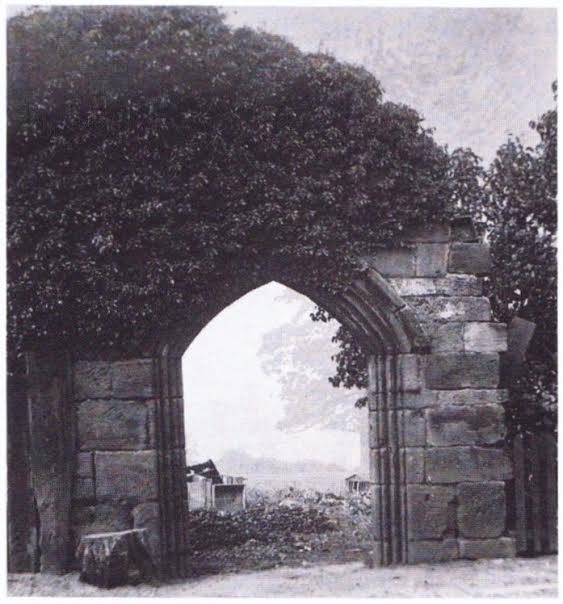 |
| The 14th century Gothic doorway of the Old Hutte. None of these remnants of the Irelands' ancestral seat are now in existence. |
Hale Hall was built by the first
of the two Sir Gilbert Irelands in the 1600s, the foundations being laid
between 1617 and 1626. The south front of the hall overlooked the River Mersey and as well as the main building, included a coach-house, stables, conservatories, dovecote and icehouse. Oddly, pone of the few remains to survive to the present say is the dovehouse.
The hall had a north front with five irregularly spaced projecting bays, with mullioned windows and gables. The second Sir Gilbert Ireland, grandson of the above, remodelled the house into a Jacobean-style manor, the previous gables being masked by a panelled parapet flush with the front of the projecting bays. A stone tablet was placed upon the tower of the building and carried the inscription "Built by Sir Gilbert Ireland, Knt, and Dame Margt, his wife, AoDi, 1674"
The building evidently remained much as it was until 1806, when Sir John Blackburne, by then the owner, added a new south front, designed by John Nash, corresponding to the north front. A stone tabled similar to the one installed by Sir Gilbert testified to the fact that the additions were made by Blackburne. The oldest and most interesting room in the house was the oak panelled room, where fine carving above the fireplace displayed the arms of the Stanley, Aspinwall, Ireland, Molineux and Hallsall families. On either side of the fireplace further panels were carved with the initials M.I. 1671 (Margaret Ireland) and G.I. 1671 (Gilbert Ireland). Around the cornice were numerous coats of arms, including those of Ireland of Hutte, Ireland of Hale, Ireland of Daresbury, Ireland and Hesketh.
The library at Hale Hall contained a museum with some notable items including a valuable coin collection and several stuffed birds that have a remote Australian connection. They had been collected by Anne Blackburne, who, like her father, was an able naturalist and ornithologist. It was after them that John Reinhold Foster, who circumnavigated the world with Captain James Cook, named Blackburnia Pinita. The American warbler, Sylvia Blackburnia, was also named after them.
Hale Hall was also noted for a fine series of several 17th century stained-glass windows, depicting in picture and verse the four seasons, the virtues, the months of the year, and a series of Roman emperors.
The hall garden and conservatories contained many rare and exotic plants including the so-called Great Palm Tree that had been presented to the Blackburnes by Lord Petre in 1737, being transplanted from their former seat to Hale Hall. The palm, fire feet round and 34 feet high, was aid to be the only one of its growth and size that had flowered and fruited in Europe, its flower similar to a vine and its fruit, though more solid, resembling in shape and colour branches of black grapes. The palm flowered for 40 years until its death in 1859. The trunk of the tree was eventually preserved in the museum of the Royal Gardens at Kew, London.
The manor park at Hale, though comparitively small, was laid out in the manner typical of early 19th century English landscape gardens, with acres of grass punctured by clumps of woodland, mostly oaks and limes, and h-ha walls to stop cattle straying.
Robert Ireland Blackburne left Hale Hall in the 1930s and when Fleetwood-Hesketh family moved there in 1947, it was virtually beyond repair. They moved instead into the Parsonage House in the village, when then became known and is still called the Manor House.
 |
| Main entrance gateposts to Hale Park and Hale Hall. |
 |
| The gracious south front of Hale Hall designed by John Nash and built in 1806. |
 |
| Buried in foliage, the ruined dovecote of Hale Hall. Doves were bred for eggs and meat as a source of food for the house. |
The hall had a north front with five irregularly spaced projecting bays, with mullioned windows and gables. The second Sir Gilbert Ireland, grandson of the above, remodelled the house into a Jacobean-style manor, the previous gables being masked by a panelled parapet flush with the front of the projecting bays. A stone tablet was placed upon the tower of the building and carried the inscription "Built by Sir Gilbert Ireland, Knt, and Dame Margt, his wife, AoDi, 1674"
 |
| Stone tablet "Built by Sir Gilbert Ireland 1674". |
 |
| A view of the oak-panelled room, in its time on of the oldest and most interesting of Hale Hall's many rooms. |
The library at Hale Hall contained a museum with some notable items including a valuable coin collection and several stuffed birds that have a remote Australian connection. They had been collected by Anne Blackburne, who, like her father, was an able naturalist and ornithologist. It was after them that John Reinhold Foster, who circumnavigated the world with Captain James Cook, named Blackburnia Pinita. The American warbler, Sylvia Blackburnia, was also named after them.
Hale Hall was also noted for a fine series of several 17th century stained-glass windows, depicting in picture and verse the four seasons, the virtues, the months of the year, and a series of Roman emperors.
The hall garden and conservatories contained many rare and exotic plants including the so-called Great Palm Tree that had been presented to the Blackburnes by Lord Petre in 1737, being transplanted from their former seat to Hale Hall. The palm, fire feet round and 34 feet high, was aid to be the only one of its growth and size that had flowered and fruited in Europe, its flower similar to a vine and its fruit, though more solid, resembling in shape and colour branches of black grapes. The palm flowered for 40 years until its death in 1859. The trunk of the tree was eventually preserved in the museum of the Royal Gardens at Kew, London.
The manor park at Hale, though comparitively small, was laid out in the manner typical of early 19th century English landscape gardens, with acres of grass punctured by clumps of woodland, mostly oaks and limes, and h-ha walls to stop cattle straying.
Robert Ireland Blackburne left Hale Hall in the 1930s and when Fleetwood-Hesketh family moved there in 1947, it was virtually beyond repair. They moved instead into the Parsonage House in the village, when then became known and is still called the Manor House.
There are various mementos of
the Ireland family in Hale village church, which is built on the site of an
earlier chapel. Little is known about the early church except that it was dedicated to St Mary. In 1308 Adam Irelande built a new aisle there and restored the
stained glass windows. In the east window are depicted the figures of St George and St Christopher, a fact that was recorded in some lines from a poem titled Iter Lancastrense by the Rev Richard James in 1616.
"Againe him painted with Saint George do see
In ye East windowe, Hylin, Lett thy penne,
Twice big as life Saint Christopher doth stand,
One giant stone, and in Hale Chappell wee
At Norton Abbye, not yet Brookes land,
Once more from hence prove yet theis shews were men".
The Hale church was replaced in the 14th century, the present tower alone dating from that time, the rest of the church having been replaced yet again.
There are two graves inside the church, both near the chancel, one of John Irelande (described as John Yerlond), buried in 1462. The other tomb is that of the families who lived at Hale Hall, on which the epitaph reads: “Gilbert Ireland Knt.M.P. Obt. 1675. Aetat 51. Ultimus Domus Fiat Voluntas Dei”.
A complete peal of six bells hangs in the bell chamber, all dating from 1814, but an earlier ring of five bells included one inscribed "John Ireland of the Hutt Esquire the founder hereof". A small bell displayed in the Church is embossed with thew date 1593 and the initials G.I. (Gilbert Ireland). It was known as the Dinner Bell and hung in the courtyard of Hale Hall until the hall was demolished in the 1930s.
References:
Peter Hatton. "A history of Hale".
J.Paul Rylands, FSA "The Hutt in Hale Wood: The Seat of the Hollands and the Irelands". Article in
The old Halls of Lancashire and Cheshire".
"Againe him painted with Saint George do see
In ye East windowe, Hylin, Lett thy penne,
Twice big as life Saint Christopher doth stand,
One giant stone, and in Hale Chappell wee
At Norton Abbye, not yet Brookes land,
Once more from hence prove yet theis shews were men".
The Hale church was replaced in the 14th century, the present tower alone dating from that time, the rest of the church having been replaced yet again.
There are two graves inside the church, both near the chancel, one of John Irelande (described as John Yerlond), buried in 1462. The other tomb is that of the families who lived at Hale Hall, on which the epitaph reads: “Gilbert Ireland Knt.M.P. Obt. 1675. Aetat 51. Ultimus Domus Fiat Voluntas Dei”.
A complete peal of six bells hangs in the bell chamber, all dating from 1814, but an earlier ring of five bells included one inscribed "John Ireland of the Hutt Esquire the founder hereof". A small bell displayed in the Church is embossed with thew date 1593 and the initials G.I. (Gilbert Ireland). It was known as the Dinner Bell and hung in the courtyard of Hale Hall until the hall was demolished in the 1930s.
 |
| Hale church contains various mementos of the Ireland family. John Irelande (died 1462) and Gilbert Ireland (died 1675) were buried in this church. |
 |
| Modern gates leading to what were once the coach house and stable yards to Hale Hall. The building in the background is the stable. |
References:
Peter Hatton. "A history of Hale".
J.Paul Rylands, FSA "The Hutt in Hale Wood: The Seat of the Hollands and the Irelands". Article in
The old Halls of Lancashire and Cheshire".
Footnotes:
1. The word "hale" derives from the Anglo-Saxon "healh", which means either a small corner of land, as in the angle of a river, a nook or secluded piece of land, or, like haugh, the Scottish and north of England term for a low lying river meadow (from the old English "halh").
2. It seems the King virtually paid Middleton to leave, as a wrestling match had been arranged with the King's champion wrestler. When Midddleton dislocated his opponent's thumb, much to the dismay of courtiers who had all put their money on the King's champion, it was evidently decided he should be sent on his way before further damage could be done. Middleton was then "sent back, the King giving him, as it is said, 20 pounds". According to Matthew Gregson's Portfolio of Fragments 1817, Middleton returned home via Oxford, where at Brasenose College, Sir Gilbert Ireland's old college, he had his portrait painted. A second, life-sized, portrait used to hang in Hale Hall and was probably painted for Sir Gilbert. Samuel Pepys recorded in his diary on June 9, 1668 that on a visit to Brasenose, he saw the "hand of the Childe of Hale", which was an outline on a gilt background of one of Middleton's hands, hanging near a cellar, said to have been 16 inches long. In 1768 Middleton's remains were disinterred and measured. It was found that his thigh bones were each as long as the length from hip to feet of the average sized man".
3. A Cecilia de Columbers is referred to in history of the village church of Stogursey, in Somerset (The Priory Church of St Andrew, Storursey, by Richard Ballard - Stogursey PCC 1982). This Cecilia was descended from a Philip de Comumbers, who obtained the manor of Nether Stowey in Somerset. Philip was dead before 1188 and was succeeded by his son, also Philip, who married Cecilia de Vernai and died in 1216, leaving children. His widow, by then Cecilia de Columbers, was still alive in 1257, as was the de facto wife of Richard de Meath, so it is possible, though by no means certain, she was one and the same person. William Fergusson Irvine, in his monograph, The Origin of the Irelands of Hale, (Transactions of the Historic Society of Lancashire and Chester, 1900) notes that the arms of the Somersetshire family of Columbers bear a close resemblance to the traditional arms of Cecilia de Columbers. There is an intriguing link with this Somerset Cecily and the De Courcys.. The Vernai (later Verney) familuy were the squires of the manor of Fairfield, a short distance from the village of Stogursey, near Bridgewater in northern Somerset. Stogursey was originally Stoke Courcy and named after th De Courcy family, wo, it is said, built the castle on the outskirts of the village (of which little remains). (See the De Courceys). The Church of St Andrew, Stogursey, was part of a Benedictine monastic priory founded from Lonlay in France and further connected with the De Courcys by the fact that when John De Courcy of Ulster founded Black Abbey at Ards in County Down, monks from Stogursey helped to build it and some went there as foundation members.
4. The Battle of Bosworth field was fought in 1485 near the Leicestershire market town from which it takes its name. In this last battle of the War of the Roses, the forces of the Yorkist Henry, Earl of Richmond, destined to be Henry V11 triumphed over the forces led by Richard 111. Treachery had much to do with the result, for many of Richard's troops led by Lord Stanley, who later put the crown on Henry's head, deserted their post before the battle and were followed by a second contingent under the Duke of Northumberland, overthrowing Richard 111.
(Modern Encyclopaedia Illustrated, Odhams Press Ltd, London, 1961).
5. Recusant (Fr, from Latin recusans, re-against, causa, a cause) one refusing to comply, especially a Catholic refusing to comply with Anglican worship or acknowledge the supremacy of the Church of England at the time of the Reformation.
6. In 1678, Titus Oates invented a story that Roman Catholics were plotting to assassinate the king of England and destroy Protestantism. He called the supposed plan the Popish Plot. Oates claimed knowledge of Jesuits working for the downfall of Charles 11. Preying on the intense suspicion of Catholics at the time, he was treated as a hero but in 1685 he was charged with perjury, fined and imprisoned over the escapade.
(World Book of Encyclopaedia, World Book Inc, Chicago, 1985).
7. Peninsular War (1808-1814). The war on the Spanish-Portuguese Peninsula between French troops of Napoleon and the voluntary forces of Spain and Portugal aided by English troops and supplies. In 1807 the Spanish Government had allowed French troops to cross Spain soil to attack Portugal. After the conquest of Portugal, the French imprisoned the Spanish king and his heir and in July 1808, Napoleon proclaimed Joseph Bonaparte, his brother, king of Spain. This complete disregard for Spanish national feeling led to outbreaks in the Spanish provinces of insurrections under the leadership of revolutionary juntas. The British Government promptly pledged support to the revolutionary movement and in August 1808, the British Army under Sir Arthur Wellesley (later Duke of Wellington) landed in Portugal and advanced into Spain. At this point Napoleon himself took command of the French forces, drove the British back and reinstated his brother, who had been forced to flee Madrid. Napoleon, however, was soon compelled to leave Spain for the Austrian campaign. Thereafter, the British and insurgent forces steadily pushed back the French armies, which were not trained for guerilla war.
Decisive defeats at Salamanca in 1812 and Vitoria in 1813 compelled the French to abandon Madrid in 1815. Spain was freed of all invading French troops.
(Collier's Encyclppaedia, Macmillan International Publishing Group, 1991).
Interesting Irelands
Apart from those mentions above there are various present and past Irelands of interest.
* Dr John de Courcy Ireland, the maritime historian and former schoolteacher. He wrote a PhD on Education and the sea and was awarded an honorary doctorate about 1980 by the University of Dublin for his work in maritime history. Considered one of the grand old men of Irish letters, he at one stage considered standing as a socialist candidate for the Irish presidential elections.
* Brian Ireland, onetime editor of the Guardian Weekly, which he remodelled in the 1950s. He left them eventually and went to work for a publication put out by the Geigy electronics, chemical and pharmaceutical firm. Like John, the maritime historian, he was an expert linguist and spoke some unusual languages such as Hungarian.
* Robert Ireland who practised as a doctor in Dublin, serving the Dublin constabulary. He published and lectured on gynaecology and De Courcy Ireland, brother of Matilda Rowe, was born at his house at 121 St Stephen's Green.
* The Rev Edmund Stanley Ireland joined the British Association for the Advancement of Science, which was prominent in its opposition of the theories of Huxley and Darwin.
*John and Arthur Ireland, merchants of Galway from about 1810 to 1860, were prominent town councillors and both involved in public welfare issues, especially during the potato famine. Both were supported of th Young Ireland movement. There was a scandalous rigging of an election in Galway, in which some English notable was trying to get a relative into power. When the English candidate won by four votes, they were able to prove bribery. John and Arthur supported the "good" candidate and Arthur ("the good Mr Ireland", they called him) was eventually chosen as chairman of his election committee.
* Arthur Joseph Ireland was a literary critic and writed of journal articles - he died in the 1920s and gets a mention in "Who Was Who". He married Agnes Maud, an Englishwomen but lived in Ireland.
Irelands in Australia
Apart from our own ancestor, Richard Davies Ireland, at least two other lrelands migrated independently to Australia. (see Pedigree family trees for De Courcy Ireland and Susannah Stanley.)
*John De Courcy Ireland, born in 1844-5 in Galway, he migrated to Australia in 1862 and became Collector of Customs at Wodonga.
* William Timbrell de Courcy Ireland, born 1862, educated St John's College, Cambridge, migrated to South Australia in 1844. Joined the Adelaide mounted constabulary in 1884. Bought a property called Wallaroo in 1890. Married Agnes Cameron, eldest daughter of R. Cameron JO of Kapunda, Barossa Valley. Died 1929. Their son, Captain William Stanley de Courcy Ireland served at Anzac with AIF. He married Ida Adeline Wallis, daughter of John Wallis of Millicent, South Australia in 1908.
Extract from Genealogical and Heraldic Dictionary of the Landed Gentry
of Great Britain and Ireland
by John Burke Esq. (and contributed by Joy Olney).
Ireland of Robertstown House (page 635):
Ireland, William, Esq. of Robertwtown House Co.Kildare and of Low Park, Co.Roscommon, married 7 February 1802, Dorothea, only child of Samuel Arnoldi Gardiner, Esq. of Robertstown and Blackwood, and has issue,
1. Arnoldi DeCourcy Ireland born 2 January 1812.
2. Samuel Gardiner Ireland born 18 June 1814.
3. William Milton Ireland born 13 September 1815.
Lineage:
This is a branch of the ancient family of Ireland, of the Hutt and Hale, in Lancashire now represented by John Ireland Blackburne, Esq. of Orford and Hale.
William Ireland, son of George Ireland who was brother of Sir John de Ireland, the father of the great Sir Gilbert Ireland of the Hutt and Hale, married about the year 1640 the Hon Margaret DeCourcy, sister and heir of Almericus, Lord Kinsale, and shortly after settled in Ireland on a property he purchased near Athy. His only son DeCourcy Ireland Esq. was an officer in the army of William 111 and after disposing of his commission, held the appointment of sole agent of the forfeited estates in Ireland, an office then of great trust and emolument. He purchased a small property in the Queen's County, now know as Ireland's Grove. He married Miss Moore and had by her two sons.
1. DeCourcy, of Ireland's Grove, barrister-at-law, who received a pension from the Crown, in regard to his claim having, to the exclusion of his brother Richard, devised his estate to his two sisters of the half-blood, by whom it was sold to the Earl of Portarlington.
2. Richard, of whom presently.
Mr DeCourcy Ireland married secondly Miss Blanchfield, an heiress of the co.Kilkenny and had by her two daughters, and two sons, Hawkins and George.
The second son of the first marriage Richard Ireland Esq. an officer in the army died early in life at Killene, near Headford co. Galway about the year 1740, leaving Catherine his wife, daughter of Mark Lynch, a rich resident of Galway, an only son.
The Very Rev William Ireland, a distinguished divine Warden of the town of Galway and a Justice of the Peace for several counties. He married Magdalene, daughter of John Irwin Esq of Lyaballaly Co.Sligo, by Magdalene, his wife, daughter of John Kelly Esq of Castle Kelly, and dying at one of his rectories near the abbey of Cong co.Mayo in 1787, left (with the other sons, of whom Richard, the second, was father of Captain James Stanley Ireland of Roscommon who served with distinction as an officer in the 87th regiment, during the Peninsular War, and several daughters, of whom one married the Very Rev Edmond French, Warden of Galway: another James Stanley Esq and a child, James Hughes Esq.) an eldest son and heir.
DeCourcy Ireland Esq of Low Park co.Roscommon who married Susanna, sister of Sir Edmond Stanley M.P. Prime Serjeant and late Chief Justice of the Supreme Court of Madras, and had, with other issue, two sons.
1. William Ireland, his heir.
2. Richard Stanley Ireland M.D. of Stephen's Grove, Dublin married Miss Phayre daughter of Col and Lady Richarda Phayre. Mr Ireland died 10 January 1812 and was succeeded by his son, the present William Ireland Esq of Robertstown.
Arms - Gu., six fleurs-de-lis, three, two and one, or.
Crest - A dove and olive branch, ppr.
Motto - Amor et pax.
Seal - Robertstown House, co.Kildare.
Lineage:
This is a branch of the ancient family of Ireland, of the Hutt and Hale, in Lancashire now represented by John Ireland Blackburne, Esq. of Orford and Hale.
William Ireland, son of George Ireland who was brother of Sir John de Ireland, the father of the great Sir Gilbert Ireland of the Hutt and Hale, married about the year 1640 the Hon Margaret DeCourcy, sister and heir of Almericus, Lord Kinsale, and shortly after settled in Ireland on a property he purchased near Athy. His only son DeCourcy Ireland Esq. was an officer in the army of William 111 and after disposing of his commission, held the appointment of sole agent of the forfeited estates in Ireland, an office then of great trust and emolument. He purchased a small property in the Queen's County, now know as Ireland's Grove. He married Miss Moore and had by her two sons.
1. DeCourcy, of Ireland's Grove, barrister-at-law, who received a pension from the Crown, in regard to his claim having, to the exclusion of his brother Richard, devised his estate to his two sisters of the half-blood, by whom it was sold to the Earl of Portarlington.
2. Richard, of whom presently.
Mr DeCourcy Ireland married secondly Miss Blanchfield, an heiress of the co.Kilkenny and had by her two daughters, and two sons, Hawkins and George.
The second son of the first marriage Richard Ireland Esq. an officer in the army died early in life at Killene, near Headford co. Galway about the year 1740, leaving Catherine his wife, daughter of Mark Lynch, a rich resident of Galway, an only son.
The Very Rev William Ireland, a distinguished divine Warden of the town of Galway and a Justice of the Peace for several counties. He married Magdalene, daughter of John Irwin Esq of Lyaballaly Co.Sligo, by Magdalene, his wife, daughter of John Kelly Esq of Castle Kelly, and dying at one of his rectories near the abbey of Cong co.Mayo in 1787, left (with the other sons, of whom Richard, the second, was father of Captain James Stanley Ireland of Roscommon who served with distinction as an officer in the 87th regiment, during the Peninsular War, and several daughters, of whom one married the Very Rev Edmond French, Warden of Galway: another James Stanley Esq and a child, James Hughes Esq.) an eldest son and heir.
DeCourcy Ireland Esq of Low Park co.Roscommon who married Susanna, sister of Sir Edmond Stanley M.P. Prime Serjeant and late Chief Justice of the Supreme Court of Madras, and had, with other issue, two sons.
1. William Ireland, his heir.
2. Richard Stanley Ireland M.D. of Stephen's Grove, Dublin married Miss Phayre daughter of Col and Lady Richarda Phayre. Mr Ireland died 10 January 1812 and was succeeded by his son, the present William Ireland Esq of Robertstown.
Arms - Gu., six fleurs-de-lis, three, two and one, or.
Crest - A dove and olive branch, ppr.
Motto - Amor et pax.
Seal - Robertstown House, co.Kildare.
Ireland Family Tree from Gilbert De Walton who died 1196
to
the family of Captain James Stanley Ireland and Matilda Davies


I also suggest you take a look at my Post "10 Generations from William Ireland and Margaret de Courcy".

If you have any comments, additions or corrections, please contact the author of this blog, Joy Olney via email - joyolney@gmail.com


